


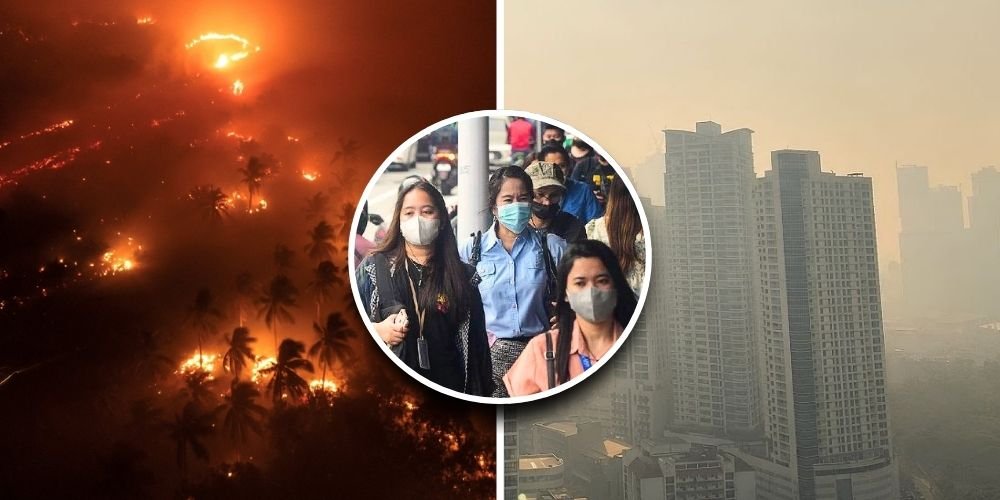
Air pollution levels across Metro Manila rose to acutely unhealthy levels Tuesday, Sept. 1, as smoke from widespread forest fires in Kalimantan, Indonesia, reached parts of the Philippines and moved northward with the southwest monsoon.
Data from the Department of Environment and Natural Resources Environmental Management Bureau showed 11 Metro Manila monitoring stations recording acutely unhealthy PM2.5 levels as of 6 a.m., exposing millions of residents to high concentrations of fine particles that can penetrate deep into the lungs.
Parañaque posted the highest reading at 296, followed by Ateneo in Quezon City at 241, Las Piñas at 237 and Manila at 231. Malabon recorded 229, while Taguig and Valenzuela each posted 224. Marikina reached 217, Muntinlupa 216, San Juan 213 and Mandaluyong 207.
The DENR-EMB said the spike in particulate pollution may be linked to smoke from active fires in Kalimantan being carried toward the Philippines by the prevailing southwest monsoon, or Habagat.
The ASEAN Specialised Meteorological Centre also detected widespread hotspots and moderate to dense smoke over Kalimantan, with transboundary haze reaching parts of Palawan and Panay.
UP atmospheric physicist Dr. Gerry Bagtasa said satellite images showed smoke traveling north from Kalimantan across the Java Sea and South China Sea.
“From the southern hemisphere, dumadaan iyong hangin dito (Java Sea and South China Sea). And then siya iyong papunta dito sa many parts ng Pilipinas. So. we can see from the satellite image, iyong forest fire siya na nanggagaling from Kalimantan, umabot siya sa Pilipinas,” Bagtasa said.
The DENR-EMB warned that haze could continue affecting parts of the country through Sept. 3 as fires remain active and the Habagat carries smoke northward. By 7 p.m. Sept. 1, however, several areas were reporting “good” Air Quality Index levels, indicating improvement.
Rain could help clear the air by washing out smoke particles, with conditions potentially improving from Sept. 4 to 6 if widespread rainfall develops and wind patterns shift.
Residents in affected areas were advised to reduce outdoor exposure, check local air-quality readings and wear N95 masks when going outside is unavoidable. Children, older adults, pregnant women and people with respiratory or cardiovascular conditions face greater risks from elevated PM2.5 exposure.