

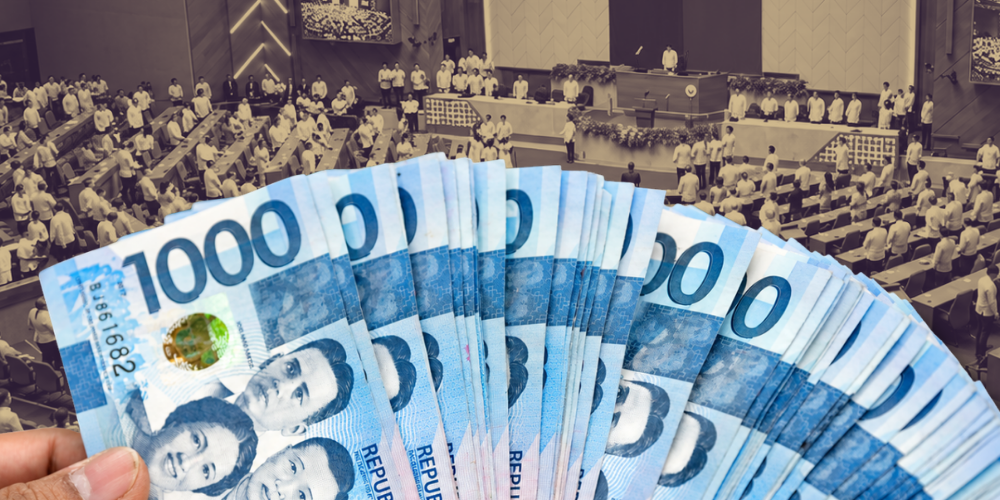
More than ₱1 trillion in questionable allocations have been identified in the House-approved 2027 national budget, watchdog People’s Budget Coalition (PBC) said during a Senate finance committee hearing on Oct. 26.
The coalition flagged ₱695 billion in what it called “hard pork” for infrastructure, ₱210 billion in “soft pork” covering assistance programs, and ₱112 billion in “shadow pork” through unprogrammed appropriations. Combined, the flagged allocations amounted to roughly ₱1.017 trillion.
The flagging came days after the Supreme Court struck down key provisions of the 2024, 2025 and 2026 General Appropriations Acts as unconstitutional over unauthorized congressional increases to unprogrammed standby funds and certain special accounts.
PBC co-convenor Kenneth Isaiah Abante raised concerns over around 7,000 infrastructure projects totaling ₱190 billion, pointing to the lack of publicly accessible supporting documents.
The Department of Public Works and Highways accounted for 6,200 inserted projects worth ₱172 billion, with most involving multipurpose buildings. Other additions included more than 180 health facilities worth ₱2 billion, over 350 farm-to-market roads valued at ₱6 billion and more than 200 irrigation projects totaling ₱7 billion.
Among the districts cited in the coalition’s findings, Ilocos Norte’s 1st District, represented by House Majority Leader Sandro Marcos, had the largest allocation on the watchdog’s list, with 405 DPWH projects worth ₱4.37 billion.
DPWH allocations linked to Isabela’s 6th District, represented by Speaker Faustino Dy III, and the province’s 4th District, represented by Rep. Joseph Tan, covered 147 projects totaling ₱1.68 billion.
Nueva Ecija’s 1st District, represented by House appropriations committee chair Mikaela Suansing, shared 107 DPWH projects worth ₱1.35 billion with the province’s 2nd District. In Batangas, the district engineering office covering areas associated with the 2nd and 5th districts recorded 77 projects worth ₱1.31 billion. The 2nd District is represented by Rep. Gerville Luistro.
Funding for the Assistance to Individuals in Crisis Situations (AICS) and Medical Assistance to Indigent and Financially Incapacitated Patients (MAIFIP) programs also increased by ₱24 billion each, alongside ₱10 billion for Presidential Assistance to Farmers and Fisherfolk.
Meanwhile, Philippine Health Insurance Corporation‘s government subsidy, which stood at ₱129.8 billion in the enacted 2026 budget, was reduced to ₱74.4 billion in the executive’s proposed 2027 budget. The House retained the lower allocation while nearly doubling MAIFIP funding to ₱49.2 billion, a spending decision questioned by the coalition.
PBC co-convenor AJ Montesa criticized medical assistance arrangements involving politicians’ guarantee letters, arguing that they could leave financially struggling patients dependent on political favors.
“Are we building a system that guarantees people their rights, or one that leaves them dependent on political favors?” Montesa said.
Major infrastructure and disaster preparedness allocations also faced reductions, including approximately ₱27 billion for the Laguna Lakeshore Road, nearly ₱20 billion for the Metro Manila Subway, ₱15 billion for the North-South Commuter Railway and ₱7.75 billion for the national disaster risk reduction and management fund.
Abante questioned the decision to prioritize additional multipurpose buildings over other pressing public needs.
“We don’t agree with the prioritization of the House for those multipurpose buildings, which we believe is not at all an urgent need of our citizens,” he said.
The coalition also took issue with foreign-assisted infrastructure projects being placed under unprogrammed appropriations, calling the funds a dumping ground for projects left out of the regular programmed budget. It warned that the setup could lead to further delays in implementation.
The watchdog stressed that its figures referred to allocations for DPWH district engineering offices rather than funds directly provided to lawmakers. It said the allocations by themselves did not prove wrongdoing and urged greater transparency and scrutiny of the proposed budget.